Titanium fasteners fill a specific niche: where you need high strength, low weight, and corrosion resistance that stainless steel cannot deliver. Grade 5 (Ti-6Al-4V) is the dominant alloy for structural fasteners, specified under ASTM F468 for bolts, screws, and studs, and ASTM F467 for nuts. This guide covers what is available, what the mechanical properties actually are, and how titanium fasteners compare to the stainless and nickel alloy alternatives you are probably evaluating alongside them.
Why Ti-6Al-4V for Fasteners
The case for titanium fasteners rests on three properties working together:
- Strength-to-weight ratio. Grade 5 titanium has a tensile strength of 900-1100 MPa at a density of 4.43 g/cm3. That is roughly the same strength as high-grade alloy steel bolts (SAE Grade 8), at 57% of the weight. Compared to A4-80 stainless fasteners, titanium is 40% lighter with nearly double the tensile strength.
- Corrosion resistance. Titanium offers excellent resistance to chloride-bearing environments and is far less prone than stainless steel to the pitting and crevice corrosion seen in marine and many chemical services. It is commonly selected for seawater, hypochlorite, and other corrosive duties where stainless fasteners have limited life.
- Low magnetic response and established medical use. Titanium fasteners are often selected where low magnetic response matters, and titanium alloys are also widely used in medical devices. For implant applications, however, the exact alloy, cleanliness, surface condition, and regulatory validation requirements must be specified separately.
Available Head Types and Configurations
Hex Head Bolts
Standard hex bolts per DIN 931 (partial thread) and DIN 933 (full thread) are the most common titanium fastener form. Available from M5 through M24, with larger sizes manufactured to order. Used in flanged connections, structural assemblies, and equipment mounting where a wrench-driven head is needed.
Socket Head Cap Screws (Allen)
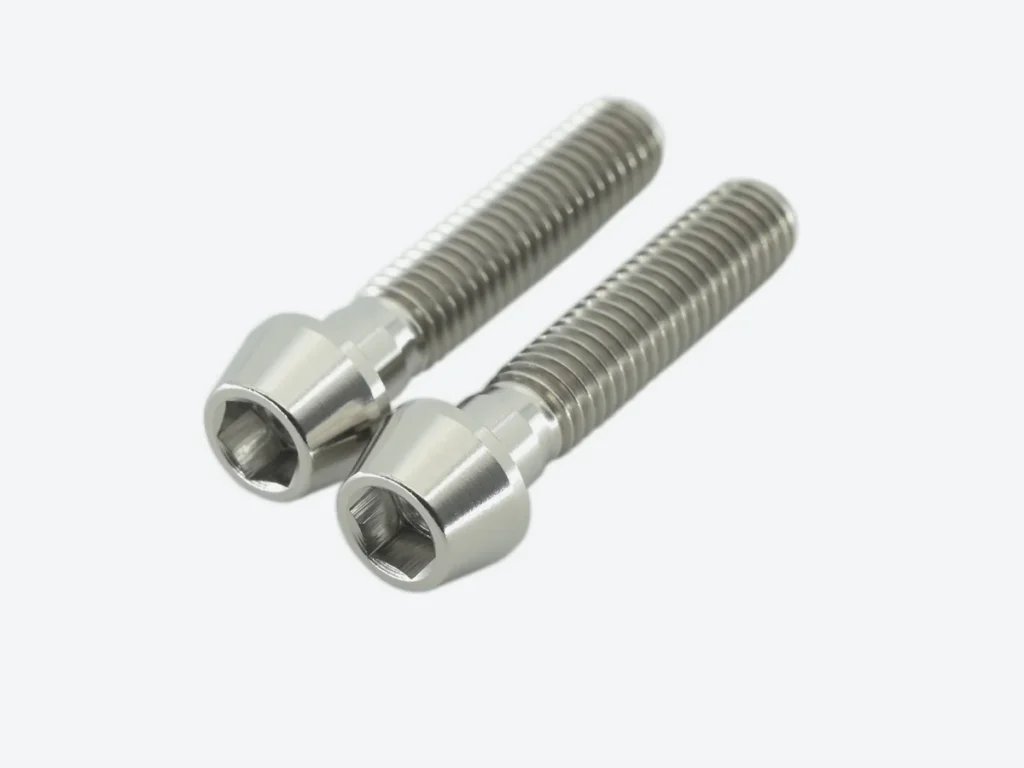
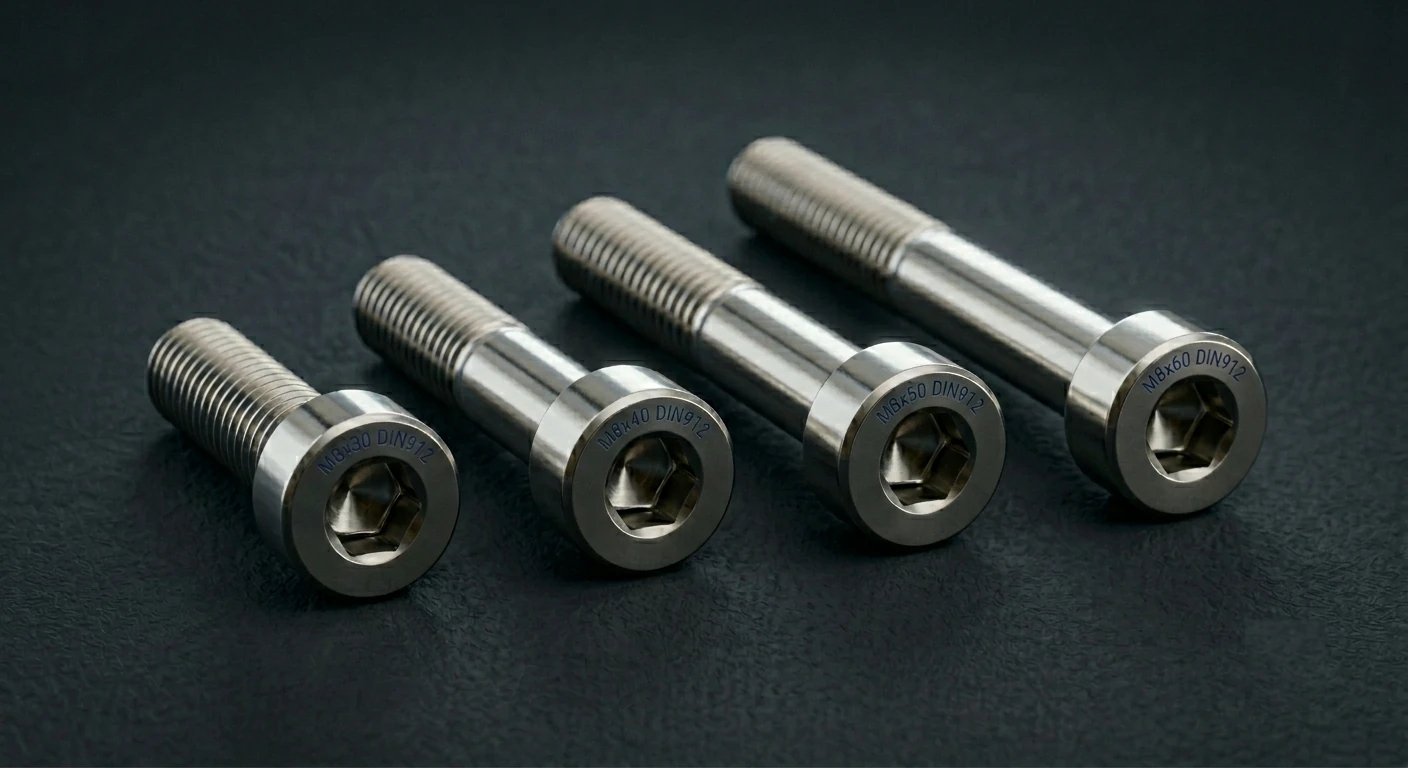
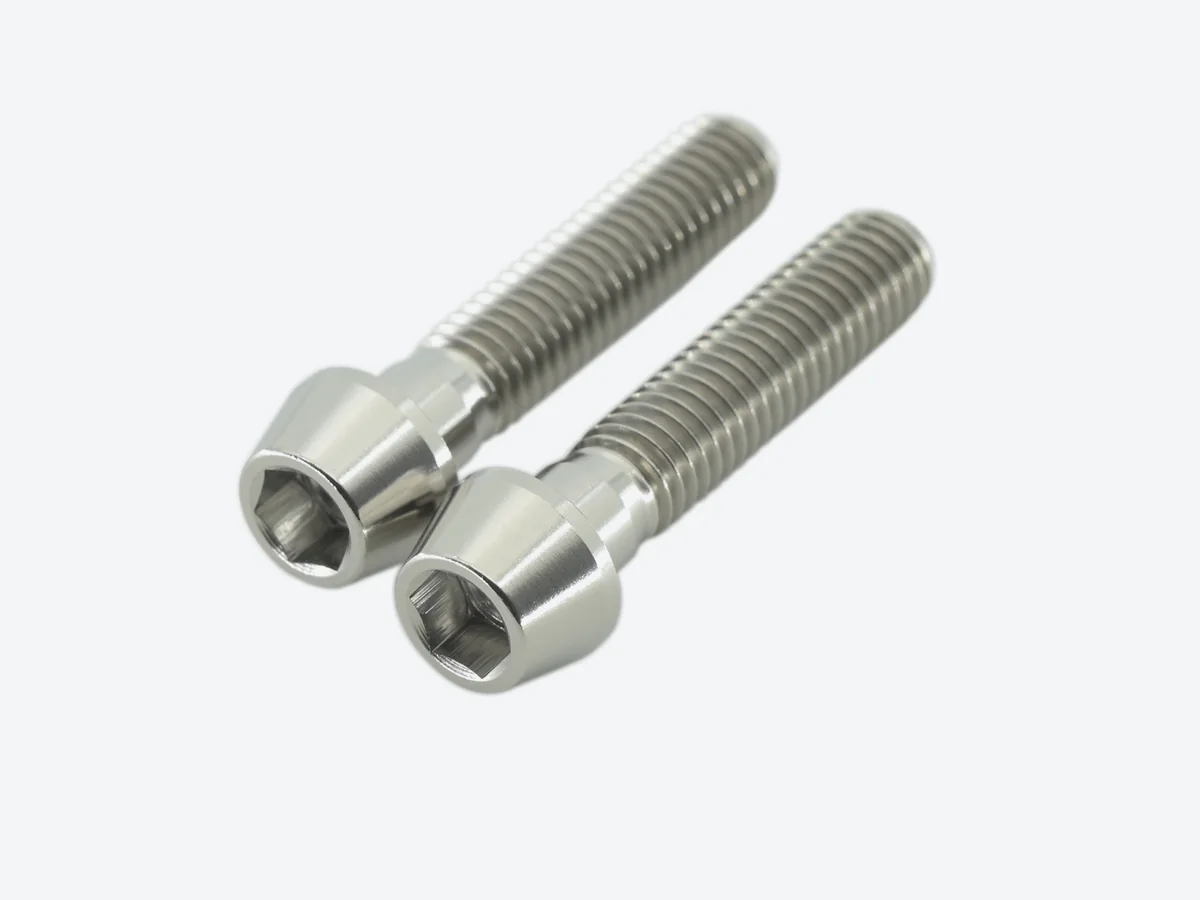
DIN 912 socket head cap screws are widely used in aerospace, motorsport, and precision equipment. The internal hex drive allows higher torque in a smaller head profile. Standard range M3 through M20.
Button Head and Countersunk Screws
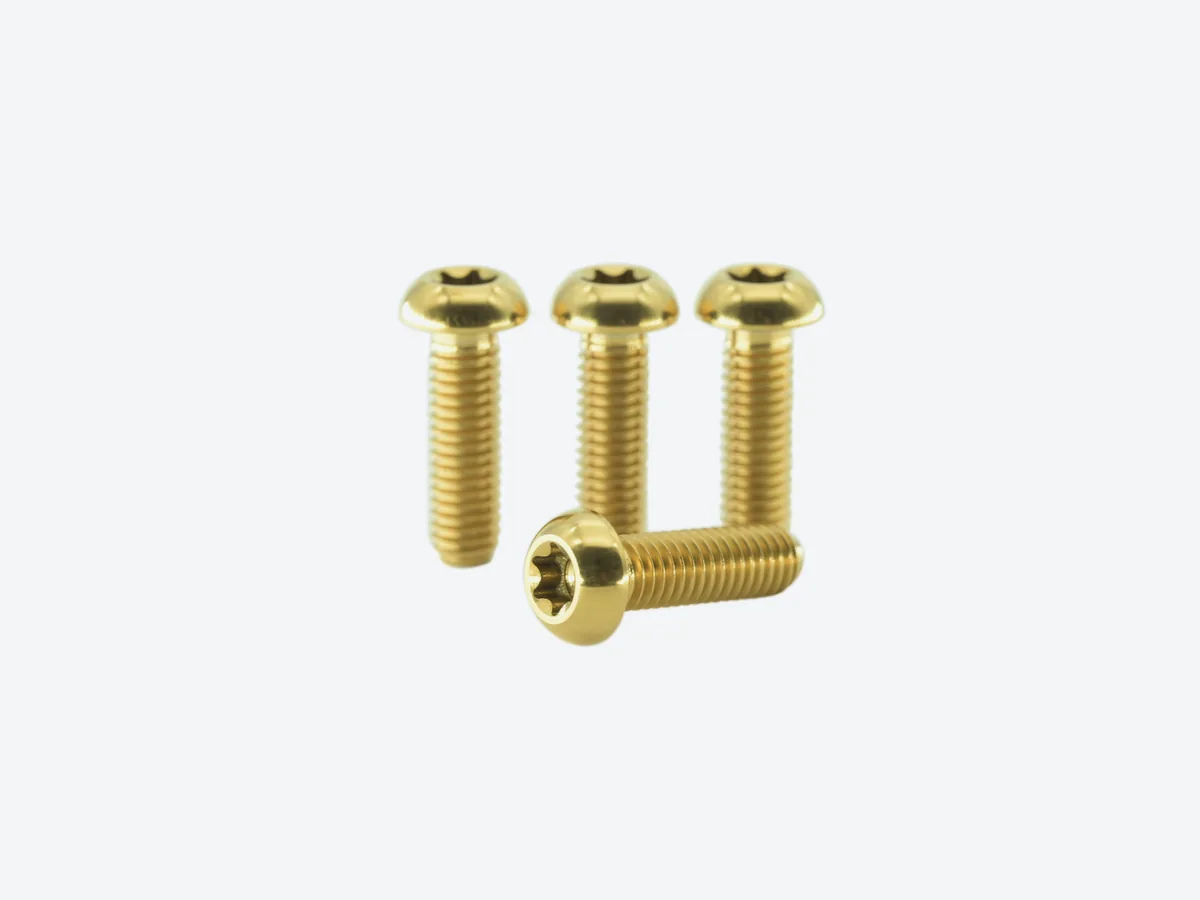
Button head (ISO 7380) and countersunk (DIN 7991) socket screws are used where a flush or low-profile head is required. Common in racing bodywork, marine deck hardware, and medical device housings.
Stud Bolts and Threaded Rod
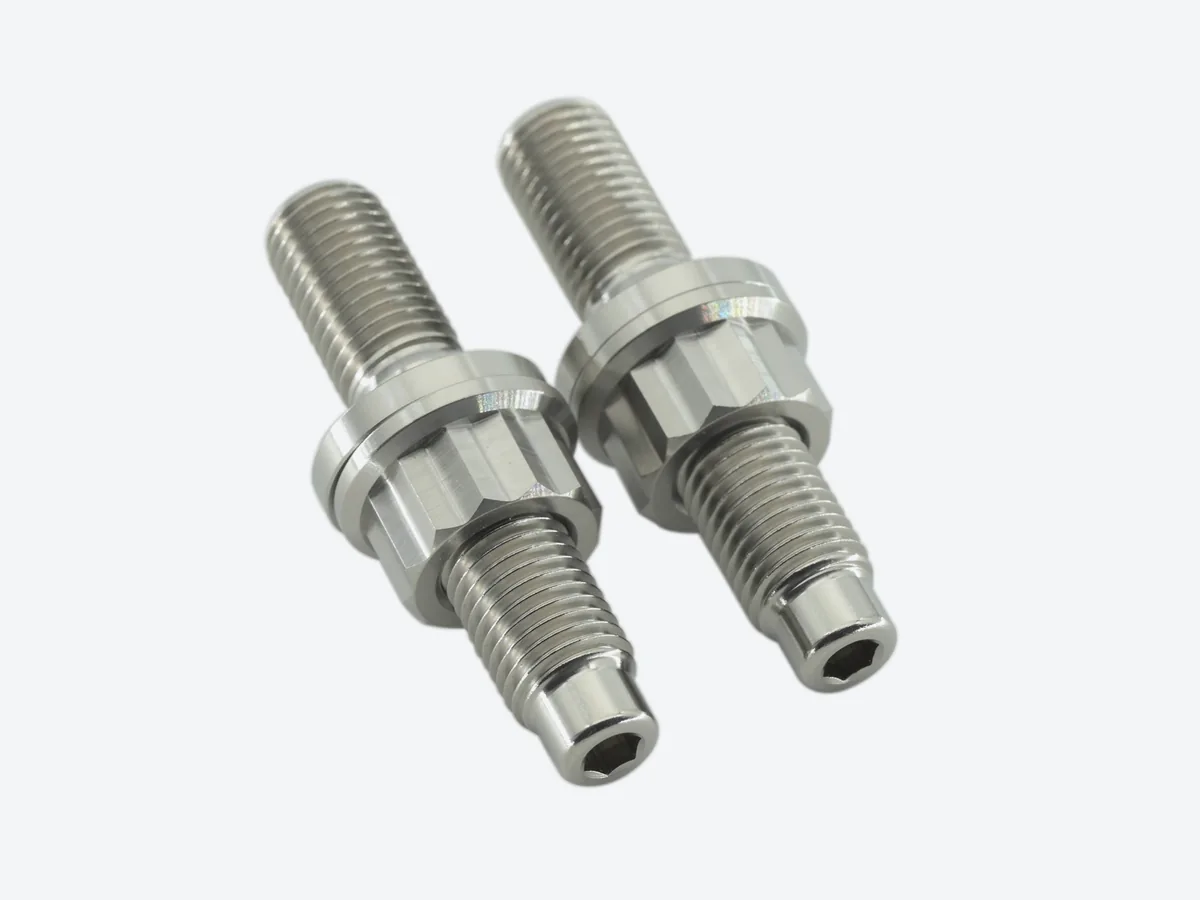
Double-ended stud bolts per ASTM F468 are used in pressure vessel and heat exchanger flange connections. Titanium studs are specified in chemical reactors, chlor-alkali cells, and offshore risers where the bolt must survive the same corrosive environment as the vessel itself.
Hex Nuts and Nylon Lock Nuts
Grade 5 hex nuts per ASTM F467, available in standard (DIN 934) and thin (DIN 439) profiles. Nylon-insert lock nuts (DIN 985) provide vibration resistance. All-titanium nut-and-bolt combinations eliminate galvanic corrosion concerns that arise when mixing dissimilar metals.
Thread Standards
Titanium fasteners are manufactured in both metric and imperial thread forms:
- ISO Metric (M3 through M24): Coarse pitch is standard stock; fine pitch is available on request. Most industrial and European specifications use metric threads.
- UNC / UNF (Unified National Coarse / Fine): Required for aerospace applications per NAS and AN standards, and for equipment designed to North American specifications. Common range #6-32 through 1″-8 UNC.
- Thread class: 6g/6H for metric (standard fit), 2A/2B for unified threads. Higher classes (4H, 3A/3B) are available for precision applications.
Mechanical Properties — Grade 5 Fasteners per ASTM F468
Tensile Strength: 900 MPa minimum (typical 950-1100 MPa)
Yield Strength (0.2% offset): 830 MPa minimum
Elongation (4D): 10% minimum
Reduction of Area: 25% minimum
Density: 4.43 g/cm3
Hardness: HRC 30-36
Shear Strength: approximately 550 MPa
Operating Temperature Range: -54 degrees C to +315 degrees C (above 315 degrees C, creep and oxidation become concerns)
Comparison: Ti Grade 5 vs Stainless Steel vs Inconel 718
The table below compares Grade 5 titanium fasteners against the three most common alternatives for corrosive or high-performance service:
Tensile Strength: Ti Gr.5 — 900-1100 MPa | SS 316 A2-70 — 700 MPa | SS 316 A4-80 — 800 MPa | Inconel 718 — 1240 MPa
Yield Strength: Ti Gr.5 — 830 MPa | SS 316 A2-70 — 450 MPa | SS 316 A4-80 — 600 MPa | Inconel 718 — 1030 MPa
Density: Ti Gr.5 — 4.43 g/cm3 | SS 316 — 7.98 g/cm3 | Inconel 718 — 8.19 g/cm3
Chloride Corrosion: Ti Gr.5 — Excellent | SS 316 — Moderate (pits in warm seawater) | Inconel 718 — Excellent
Max Service Temp: Ti Gr.5 — 315 degrees C | SS 316 — 800 degrees C | Inconel 718 — 700 degrees C
Magnetic: Ti Gr.5 — No | SS 316 — Slightly (cold-worked) | Inconel 718 — Slightly
Relative Cost: Ti Gr.5 — High | SS 316 A2-70 — Low | SS 316 A4-80 — Medium | Inconel 718 — Very high
The key takeaway: titanium wins on weight and chloride resistance. Inconel 718 wins on absolute strength and high-temperature service. Stainless A4-80 is the budget option when corrosion conditions are moderate and weight is not critical.
Applications by Industry
Marine and Offshore
Subsea equipment, shipboard exhaust systems, desalination plants, and offshore platform piping. The combination of low weight, strong seawater corrosion resistance, and good fatigue performance makes titanium a strong option for joints submerged or splash-zone exposed for long service periods.
Aerospace
Grade 5 fasteners are used in airframe joints, landing gear assemblies, and turbine engine casings. Aerospace titanium fasteners require full material traceability and are typically manufactured to NAS or NASM specifications.
Chemical Processing
Flanged joints on titanium reactors, heat exchangers, and piping require titanium bolting to avoid galvanic corrosion between the titanium vessel and a dissimilar fastener. Stud bolts and heavy hex nuts in M16 through M24 are the most common sizes in this sector.
Motorsport and Medical
In motorsport, socket head and button head screws in M5 through M10 replace steel fasteners on engines, suspension, and bodywork — the 40% weight savings multiplied across hundreds of fasteners adds up fast. In medical applications, implant-grade components typically use Grade 5 ELI (Grade 23) rather than standard industrial Grade 5, with the final device validated to the applicable medical standard.
Surface Finish Options
- Natural (as-machined or as-rolled): The standard finish. Titanium’s native oxide layer provides full corrosion protection without any coating. Most industrial fasteners ship in this condition.
- Anodized (colored): Controlled oxide thickness produces interference colors — blue, purple, gold, green — without dyes or paints. Used for identification coding (torque values, material grades) and aesthetic applications. The coating is thin (0.5-2.5 micrometers) and does not significantly affect dimensions or thread fit.
- Silver or nickel plated: Prevents galling and seizure in high-temperature aerospace applications. Silver plating per AMS 2410 is the standard anti-galling treatment for titanium bolts in turbine engines.
- Wax or PTFE coating: Thread lubricants to reduce galling risk during assembly. Titanium galls readily against itself and against stainless steel when dry-assembled under high torque.
Anti-Galling: A Practical Note
Titanium galls easily. If you torque a dry titanium bolt into a titanium nut without lubrication, there is a high risk of seizure — the thread surfaces can cold-weld together under pressure. In practice, titanium threaded connections are usually assembled with an anti-seize compound, an appropriate plated finish, or a wax/PTFE lubricant chosen to suit the service environment.
FILTURE supplies Grade 5 titanium fasteners — hex bolts, socket head cap screws, button head screws, stud bolts, and nuts — in metric sizes M3 through M24 per ASTM F468/F467. Custom lengths, non-standard head configurations, and coated finishes are available on request. See our full titanium fastener catalog, or send us your specification for pricing.