Some industrial environments are hard on filter cartridges. High temperatures, aggressive chemicals, high pressure, radiation, and heavy particulate loading can destroy standard filter media in weeks.
Sintered stainless steel wire mesh cartridges are designed specifically for these conditions. This article explains why — covering the manufacturing process, the specific environments where they perform best, and the long-term cost case for using them.
Why Sintering Makes the Difference
Standard wire mesh cartridges are made by weaving wire into a screen — the wire intersections aren’t bonded, they’re just held by tension. Under repeated pressure, thermal cycling, or aggressive backwashing, these intersections can shift. Pore size changes. Filtration performance drifts.
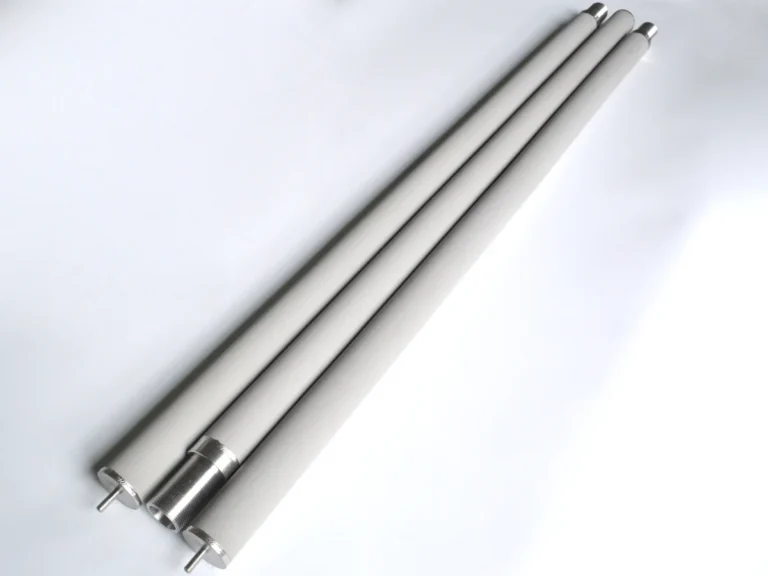
Sintered cartridges are different. Multiple mesh layers are stacked and placed in a vacuum furnace at up to 1100°C. At that temperature, the contact points between wires in adjacent layers fuse together through solid-state diffusion. The result is a single rigid porous structure — not a stack of separate layers.
The standard five-layer design:
- Outer protection layers — coarser mesh, provides structural support, catches large particles
- Filtration control layers — precision mesh, defines the actual micron rating
- Inner support layer — maintains structural integrity under reverse flow during backwash
This layered approach means the fine filtration layers are protected. The cartridge handles backwash forces without the mesh deforming or pore sizes changing.
Where Sintered SS Cartridges Are the Right Choice
Chemical Processing with Aggressive Media
Chemical plants work with acids, caustics, and solvents that degrade polymer and fiber filter media within weeks. Sintered stainless steel is chemically inert to most industrial chemicals. The filter retains its rated micron performance in corrosive environments where disposable cartridges would need constant replacement.
Typical applications: catalyst recovery, process stream filtration, chemical solvent clarification.
High-Temperature Gas Filtration
Fabric and polymer filters are limited to operating temperatures around 150–200°C. Above that, they distort or burn. Sintered stainless steel operates continuously at up to 480°C, with short-term excursions to 600°C.
This makes sintered cartridges the practical choice for dust collection in power generation, gas turbine inlet filtration, and hot gas cleaning in process plants. The filter keeps its shape and keeps working even when ambient temperatures are too high for any organic media.
Pharmaceutical Manufacturing
Pharmaceutical processes require filters that can be steam-sterilized multiple times without losing performance — and that don’t shed any material into the product stream.
Sintered SS cartridges meet both requirements. The rigid bonded structure doesn’t change dimensionally after sterilization. There are no fibers or particles to shed — it’s all metal. And the filter can be validated: the buyer validation protocol should define the accepted method and documentation batch after batch, which is exactly what FDA and EMA auditors look for.
Hydraulic System Protection
Hydraulic systems are damaged by wear particles in the fluid — microscopic pieces of metal from pump and valve wear. Sintered stainless steel cartridges provide precise, consistent particle retention in high-pressure hydraulic fluid without the risk of media collapse under pressure spikes.
The rugged construction handles vibration and pressure surges that destroy conventional pleated media. Equipment operators who switch to sintered metallic cartridges typically report extended intervals before hydraulic component wear becomes a maintenance issue.
Food and Beverage Processing
Food-contact filtration has to meet FDA surface cleanliness requirements and survive CIP (clean-in-place) cycles with hot caustic solutions at 80–90°C. Stainless steel is the material of choice for exactly this reason — it’s easy to clean, doesn’t harbor bacteria in surface pores, and is compatible with all standard food-grade sanitizers.
Beverage clarification, yeast removal in fermentation, and water treatment in bottling plants are all common applications.
Water Treatment — Municipal and Industrial
Municipal water treatment plants deal with variable contamination loads. Seasonal runoff, algae blooms, or industrial discharge changes what’s in the water. Sintered cartridges handle fluctuating particulate without blinding (sudden severe clogging) as readily as fiber depth filters do.
The backwash capability is significant: you clean the cartridge in place without removing it, which matters in large-scale installations where taking a filter offline has operating consequences.
Aerospace and Defense
Aircraft hydraulic and fuel systems need filtration that remains reliable under extreme vibration, thermal cycling, and high-G conditions. Sintered SS cartridges are specified in these applications because there’s no media integrity risk — the bonded structure won’t collapse or shed particles regardless of what the airframe is doing.
Material Selection for Harsh Environments
Grade
When to use it
SS304
General duty — water, non-aggressive chemicals, moderate temperatures
SS316L
Chloride environments, seawater, chemical processing — better pitting resistance
904L
Highly aggressive acid service, seawater desalination
Hastelloy C-276
Severe corrosion environments where 316L or 904L are insufficient
The ‘L’ in 316L matters in harsh environments: the low carbon content prevents sensitization during welding and high-temperature operation, preserving corrosion resistance at weld zones.
Economic Case: Why Sintered SS Often Costs Less Long-Term
Sintered SS wire mesh cartridges cost more than disposable options upfront. The total cost picture over 2–3 years usually looks very different:
- Reusable design: clean and restore rather than replace
- Typical cleaning cycle restores 95–98% of original flow performance
- Cartridges typically survive 50–100 cleaning cycles before replacement is needed; with careful maintenance, this can exceed 200 cycles
- Fewer changeouts = less maintenance labor and less planned downtime
- Predictable maintenance schedule instead of reactive emergency changeouts
Disposal costs also disappear. Contaminated disposable filters need to be handled as waste — sometimes as chemical waste, which has its own cost and compliance requirements. A sintered SS cartridge goes into a cleaning bath, not a waste bin.
Installation and Maintenance
A few practices that extend service life:
- Torque end caps to manufacturer specification — overtightening can distort the seal
- Verify gasket material compatibility with the process fluid before installation
- Monitor differential pressure: clean when ΔP rises 0.5–0.8 bar above baseline
- Use the right cleaning method for the fouling type — backflush for surface deposits, ultrasonic for embedded particles, chemical soak for scale
- For critical service, use a post-cleaning inspection and performance-verification plan agreed for the process
Frequently Asked Questions
What’s the difference between sintered and pleated wire mesh?
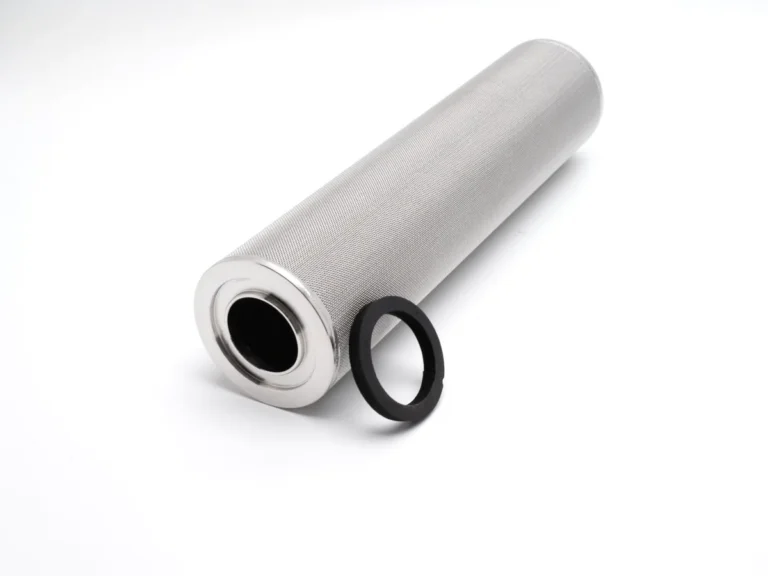
Sintered cartridges have a rigid structure with all wire intersections permanently bonded. The pore size doesn’t change under pressure or thermal stress. Pleated cartridges use the same mesh material in a pleated configuration, giving more surface area in the same housing. For harsh environments — high pressure, aggressive chemicals, steam sterilization — sintered construction is more reliable. For high-flow, lower-pressure applications, pleated designs offer more filtration area.
How do cleaning cycles affect filtration performance?
Properly done, cleaning restores 95–98% of original flow capacity. The sintered structure is robust enough to handle repeated backwash and chemical cleaning without mechanical damage. Performance typically degrades gradually over many cleaning cycles, not suddenly — you’ll see it in the differential pressure trend before it becomes a problem.
Can the same cartridge filter both gas and liquid?
Yes, sintered SS cartridges handle both. The flow rate and pressure parameters differ between gas and liquid service — gas filtration typically runs at higher volumetric flow with lower pressure drop. If you’re switching a cartridge between gas and liquid service, verify that the flow conditions in both cases are within the cartridge’s rated operating range.
Talk to FILTURE About Your Filtration Needs
Every filtration job is different. If you’re not sure which cartridge fits your system, see the full specifications for our SS Pleated Mesh Filter Element and SS Sintered Mesh Filter Element, or request a quote with your dimensions, micron rating, and operating conditions.
Prefer email? Reach us at sam.young@filturemetal.com — we’ll get back to you with a straight answer, no sales pitch.