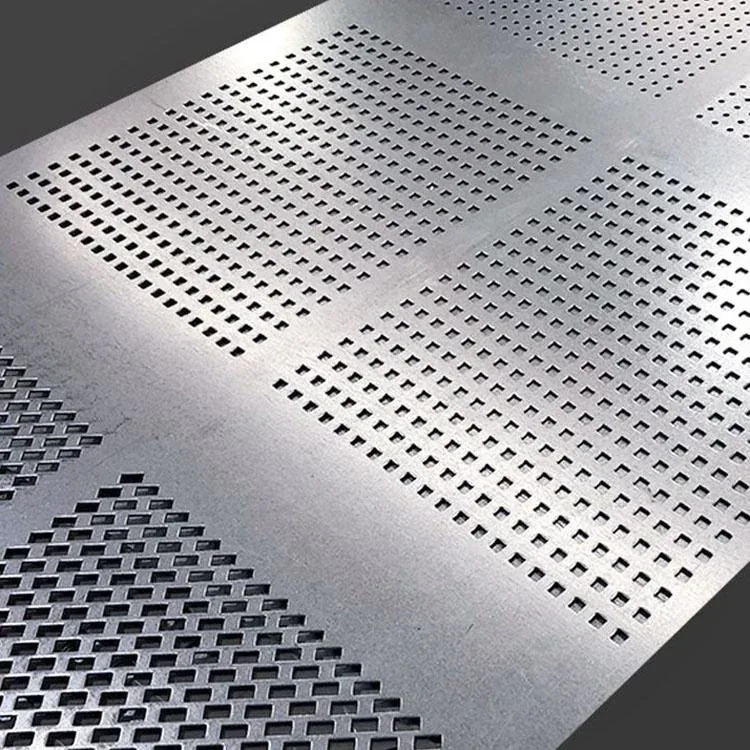
Perforated titanium sheet is one of the simpler product forms in the porous metals family — flat sheet with punched or drilled holes in a regular pattern. But simplicity is a feature, not a limitation. Perforated sheet gives you predictable open area, high structural strength, and the full corrosion resistance of titanium in a format that is easy to fabricate, weld, and install. This article covers the available specifications, hole patterns, and the applications where perforated titanium outperforms stainless steel alternatives.
Material Grades
Perforated titanium sheet is produced from flat mill stock conforming to ASTM B265. The two standard grades are:
- Grade 1 — Softest CP titanium, 240 MPa minimum tensile strength. Best formability — easier to bend, draw, and stamp after perforation. Preferred for architectural panels, forming applications, and electroplating baskets where subsequent shaping is required.
- Grade 2 — 345 MPa minimum tensile strength. The default choice for structural and process applications. Good balance of strength, formability, and weldability. Most in-stock perforated sheet is Grade 2.
Grade 5 (Ti-6Al-4V) perforated sheet is available on special order for aerospace or high-stress applications, though the higher hardness makes perforation tooling wear faster and increases cost.
Hole Patterns
Round Holes — 60° Staggered
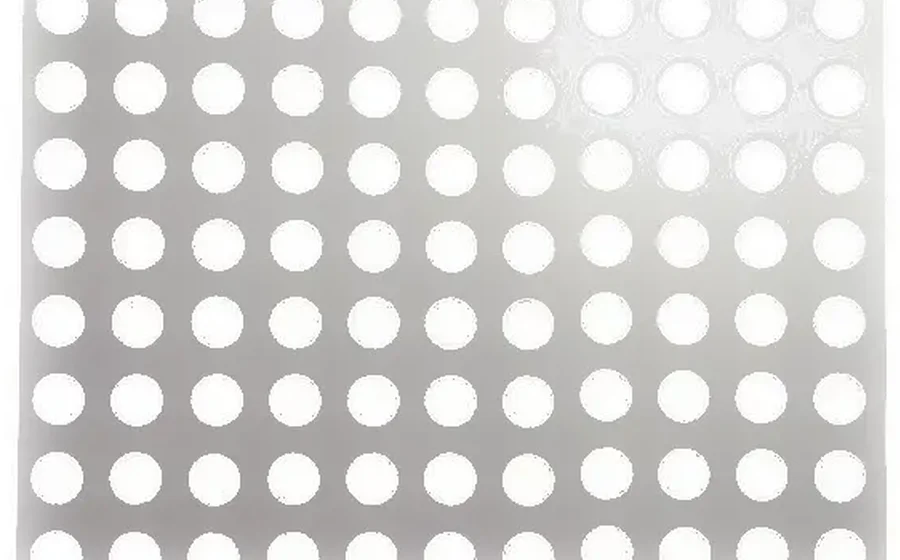
The most common pattern. Round holes arranged in a triangular (60° staggered) pitch. This layout provides the highest open area for a given hole size and sheet strength. It is the default for filtration, drainage, ventilation, and general-purpose screening. Open areas typically range from 30% to 58% depending on hole diameter and pitch.
Round Holes — Straight (90°) Rows
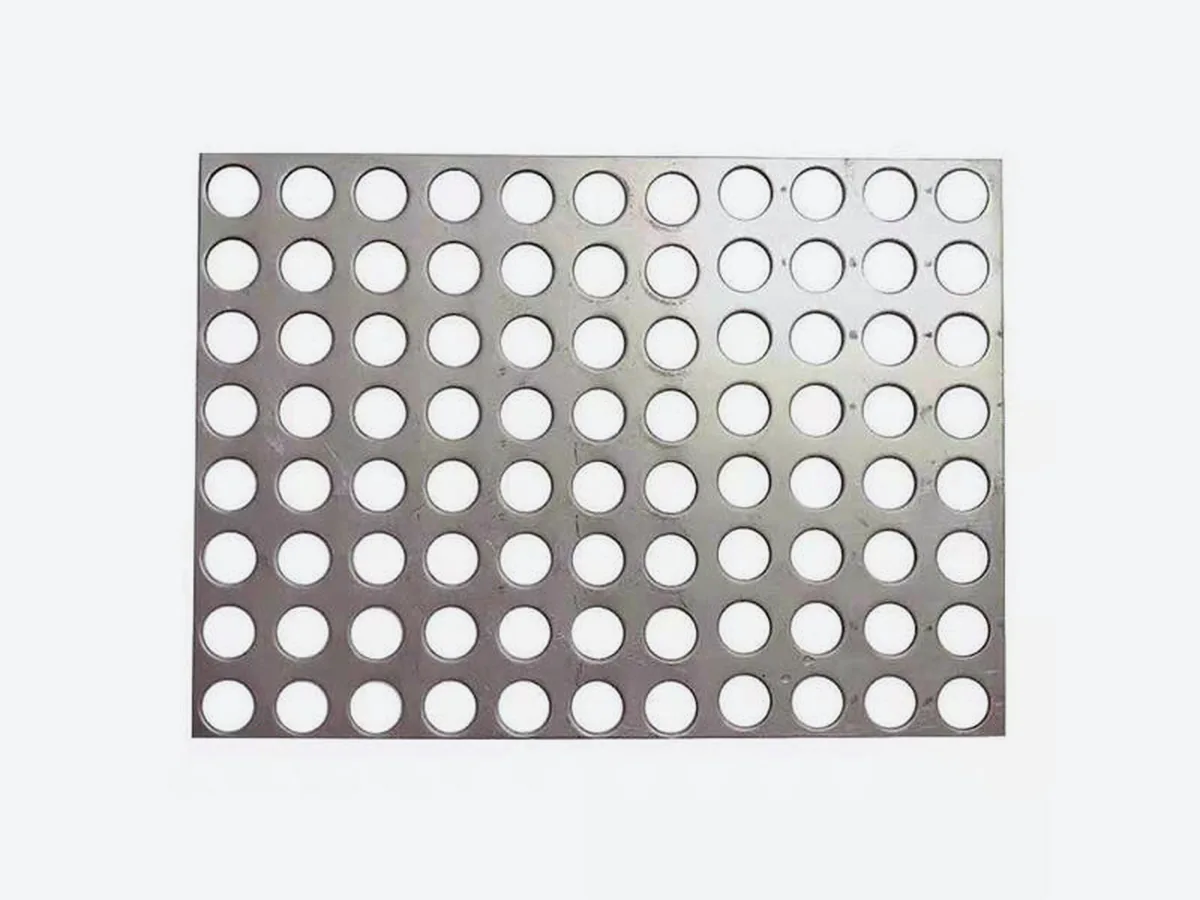
Round holes in a square grid pattern. Lower open area than staggered for the same hole/pitch ratio, but the alignment can be useful for specific flow distribution requirements or aesthetic applications. Also slightly stronger in the transverse direction compared to staggered patterns.
Square Holes
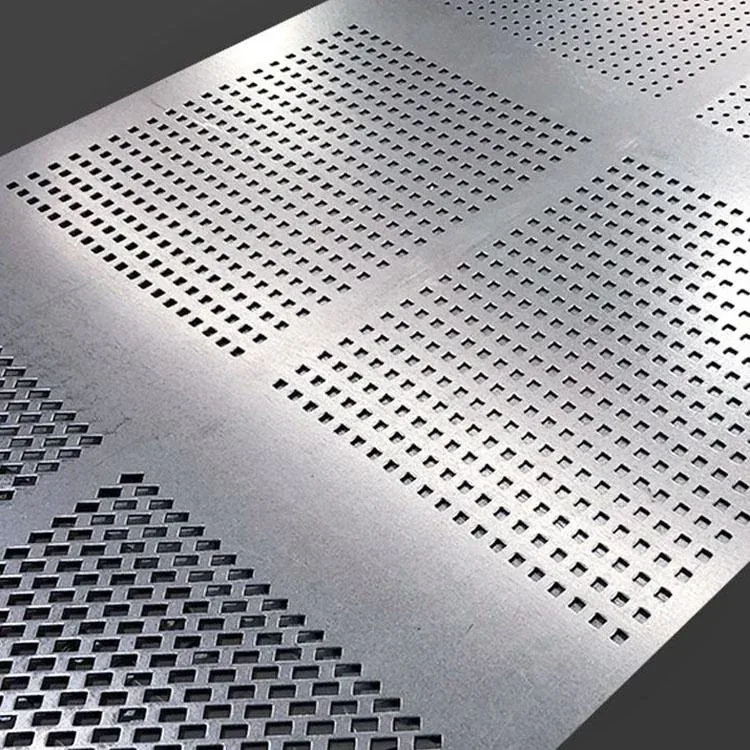
Punched square openings, typically in straight rows. Used for aggressive screening applications where the square opening provides a defined pass/reject size on the diagonal. Common in classifier screens and grading applications. Open area can reach 50–60% with tight bridge widths.
Hexagonal (Honeycomb) Holes
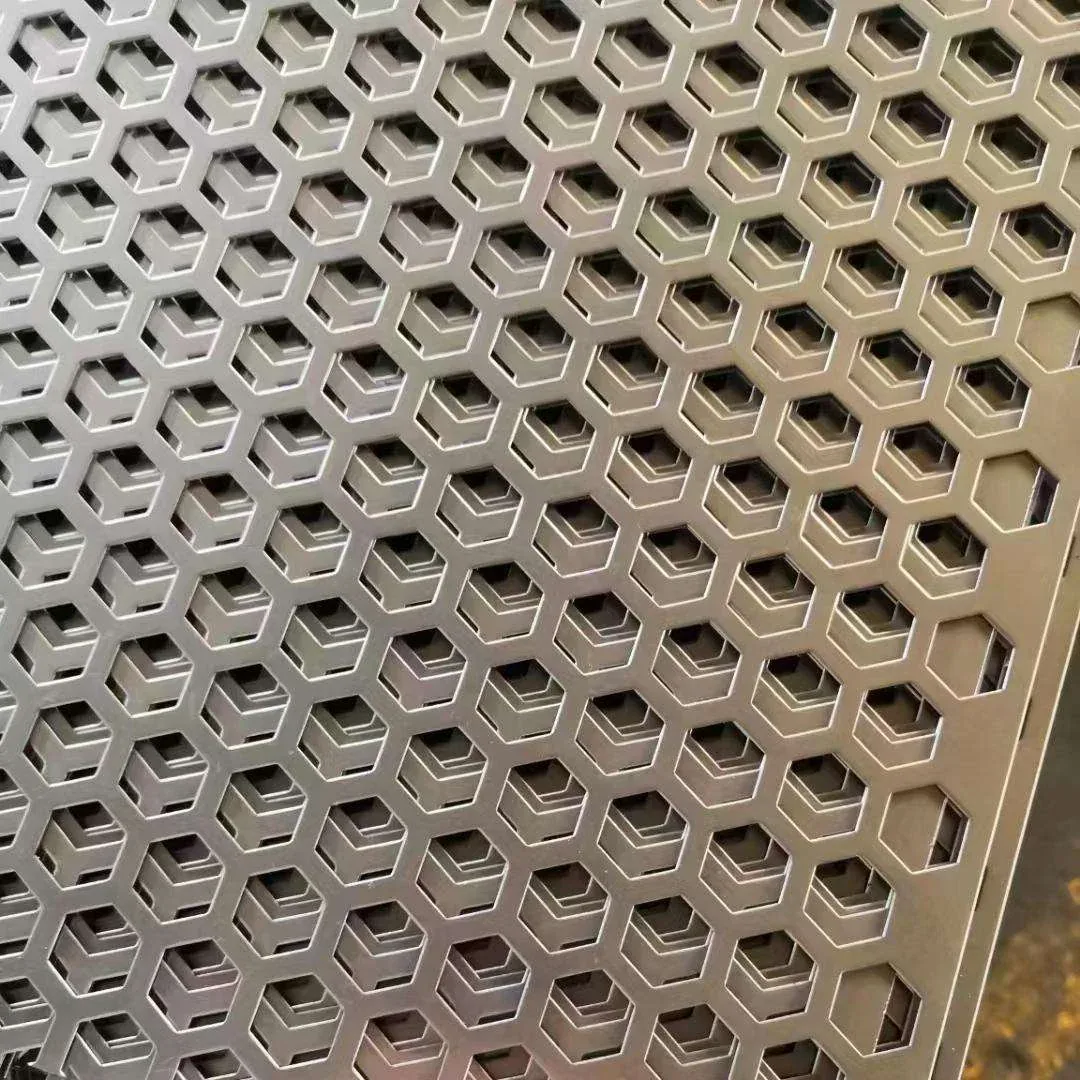
Hexagonal perforations provide high open area (up to 60%+) while maintaining reasonable structural integrity. The hex pattern distributes stress more evenly than round holes at equivalent open areas. Used in speaker grills, architectural panels, and EMI shielding applications where both airflow and aesthetics matter.
Specifications
Base material: ASTM B265 Grade 1 / Grade 2 CP Titanium
Sheet thickness: 0.5–6.0 mm
Hole diameter: 0.5–25 mm (round); 0.5–20 mm (square/hex)
Pitch: Hole center-to-center distance, typically 1.5× to 3× hole diameter
Open area: 20–60% (dependent on hole size, pitch, and pattern)
Sheet size: Up to 1000 × 2000 mm standard; custom sizes on request
Tolerances: Hole diameter ±0.1 mm, pitch ±0.15 mm, thickness per ASTM B265
Edge condition: Sheared, laser-cut, or deburred as specified
Surface finish: Mill finish, pickled, or polished
Applications
Chemical Reactor Internals
Perforated titanium sheet is used as tray decking in distillation columns, as support plates for catalyst beds, and as distributor plates in reactor vessels handling corrosive media. In chlor-alkali plants, wet chlorine gas and hot brine destroy carbon steel and attack 316L stainless at welds and crevices. Titanium trays in these columns run for decades without replacement. Hole patterns are selected to provide the required vapor/liquid distribution while maintaining the structural load capacity needed for packed bed support.
Electroplating Baskets and Jigs
Titanium baskets hold parts during plating operations in chromic acid, sulfuric acid, and mixed acid baths. The perforated construction allows electrolyte circulation while containing small parts. Titanium does not contaminate plating baths — a critical advantage over SS, which dissolves in chromic acid and introduces iron contamination that degrades deposit quality. Grade 1 is preferred here for its formability when bending baskets from flat perforated sheet.
Seawater Intake and Cooling Screens
Power plants, desalination facilities, and offshore platforms use perforated titanium sheet as intake screens and debris filters in seawater cooling circuits. Hole sizes of 3–10 mm are typical for macro-screening of marine organisms and debris. Titanium’s immunity to seawater pitting and biofouling resistance (the smooth TiO₂ surface discourages marine growth) make it the standard material for long-life marine installations.
Architectural and Acoustic Panels
Perforated titanium panels are used in high-end architectural facades, interior cladding, and acoustic treatments — particularly in coastal or industrial environments where aluminum or steel would corrode. The Guggenheim Museum Bilbao famously uses titanium cladding. Perforated variants provide ventilation, solar shading, and acoustic absorption when backed with appropriate absorber materials.
Speaker Grills and Electronic Enclosures
Thin perforated titanium (0.5–1.0 mm) serves as speaker grills and protective covers for high-end audio equipment and electronic housings. The low density and high stiffness-to-weight ratio prevent resonance, while the corrosion resistance ensures long-term appearance in any environment.
Titanium vs. Stainless Steel Perforated Sheet
The trade-off is straightforward:
- Use titanium when the application involves chlorides (seawater, brine, HCl), oxidizing acids (chromic, nitric), elevated temperatures in corrosive media, or when contamination of process fluids by dissolved metals is not acceptable. Also choose titanium when you need to minimize weight — it is 56% the density of 316L.
- Use stainless steel when the environment is not corrosive enough to justify titanium’s cost premium. 304 or 316L perforated sheet costs roughly one-fifth to one-eighth what titanium does at the same dimensions. For ambient-temperature water, mild chemicals, food processing, and general HVAC screening, stainless steel is the rational choice.
One common approach in the chemical process industry: start with 316L and switch to titanium for specific components that show repeated corrosion failure. This targets the titanium cost where it actually delivers a return.
Fabrication Notes
Perforated titanium sheet can be sheared, bent, rolled, and welded using standard titanium fabrication practices. Welding requires inert gas shielding (argon) on both sides of the joint and on the trailing weld — titanium absorbs oxygen and nitrogen above ~400 °C, causing embrittlement. For bending, a minimum bend radius of 2–3× sheet thickness is recommended for Grade 2; Grade 1 can go tighter.
For specifications and availability on titanium perforated sheet, visit the perforated sheet product page or contact us with your drawing or specification requirements.