If you’re specifying filter cartridges for a critical application, understanding what’s inside matters. The performance of a pleated SS wire mesh cartridge — how much pressure it holds, how it cleans, how long it lasts — is determined by choices made during manufacturing.
This article breaks down the construction step by step.
Material: Why 316L Stainless Steel
The base material for most pleated SS wire mesh cartridges is AISI 316L stainless steel. The ‘L’ designation means low carbon content — important because it prevents sensitization (chromium carbide precipitation at grain boundaries) during welding and high-temperature processing.
316L offers:
- Higher molybdenum content (2–3%) than 304 grade, giving better resistance to chloride pitting
- Stable performance from -200°C to 480°C continuously, up to 600°C intermittently
- Compatibility with most industrial chemicals — acids, caustics, solvents, oxidizers
For more aggressive environments, SS304 (lower cost, general duty), 904L (high-chloride), or Hastelloy (severe chemical service) are alternatives. Titanium is used in aerospace or extreme chemical applications where even high-grade stainless steel isn’t enough — see our material selection guide for a full comparison.
Wire Mesh Selection and Quality Control
Before any filter is built, the wire mesh itself is assessed. Key parameters checked at this stage:
- Wire diameter consistency — variation here translates directly to pore size variation in the finished filter
- Weave pattern uniformity — plain weave, twilled weave, and Dutch weave each produce different pore geometries
- Material composition verification — mill test reports (MTRs) are reviewed against order specifications
This step determines whether the cartridge will hit its rated micron level consistently across the entire filter surface. Poor mesh quality at this stage can’t be corrected later.
Vacuum Sintering: Where the Strength Comes From
Multiple mesh layers — typically five, with different weave grades — are stacked and placed in a vacuum furnace. The furnace heats to temperatures up to 1100°C in a controlled atmosphere that prevents oxidation.
At that temperature, the contact points between wires in adjacent layers fuse through solid-state diffusion. The layers become a single integrated structure. No adhesive, no mechanical fastening — just a metallurgical bond between wire surfaces.
The critical parameters controlled during sintering:
- Temperature profile — ramp rate, peak temperature, hold time
- Atmosphere composition — prevents oxidation while promoting bonding
- Load configuration — ensures uniform bonding across the entire mesh area
After sintering, the multi-layer panel is a rigid sheet with defined porosity. It can be cut, formed, and pleated without the layers separating.
The Pleating Process
The sintered mesh sheet is formed into accordion-style pleats using precision tooling. Each pleat must be consistent in:
- Angle — too shallow and you lose surface area; too steep and adjacent pleats block flow
- Depth — determines how much surface area gain you get per unit length
- Spacing — must allow fluid to move through freely without channeling
The pleated geometry increases effective filtration surface by up to 300% compared to a flat-sheet cylinder of the same diameter and length. This is the core engineering reason pleated designs outperform plain cylindrical mesh filters in flow capacity and dirt-holding.
Internal support structures are added to prevent pleat collapse under differential pressure or during backwash. These supports maintain the pleat geometry without restricting flow.
End Cap Assembly and Dimensional Configuration
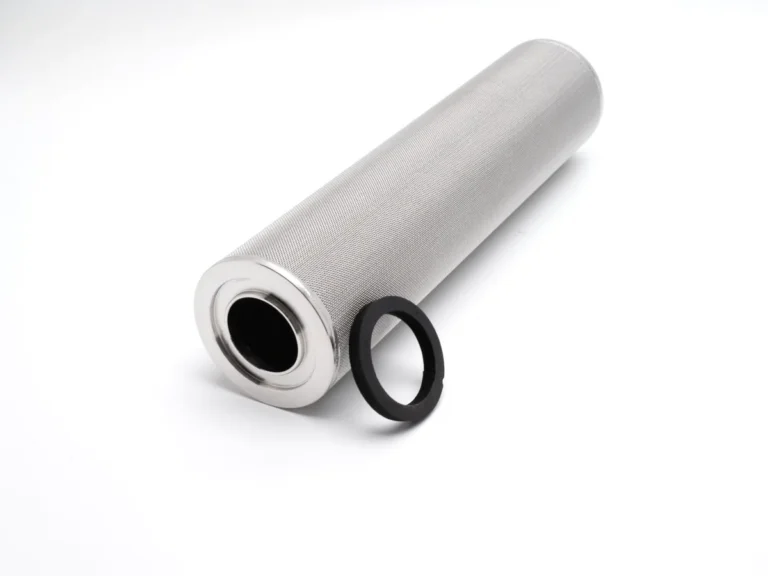
The pleated media is cut to length and fitted with end caps. Caps are welded — not bonded with adhesives — to the cartridge body. This is important: adhesive joints are a weak point in many competitor designs, especially at elevated temperatures.
Standard Dimensional Options
Dimension / Feature
Options
Outer diameter
30 mm to 350 mm standard; custom available
Length
10″, 20″, 30″, 40″, 60″ standard; custom available
End cap types
DOE (Double Open End), SOE (Single Open End), flange
O-ring groove styles
222, 226, and proprietary configurations
Connection thread
NPT, BSP threaded options
For high-pressure applications where threaded connections may be inadequate, flange connections using ANSI, DIN, or JIS bolt patterns are available.
Inspection Before Shipment
Inspection is agreed with the order requirements and can include material traceability, dimensional and visual inspection, connection verification, and application-specific flow or pressure-drop characterization.
Operating Range Summary
Parameter
Value
Temperature (continuous)
-200°C to +480°C
Temperature (intermittent)
Up to 600°C
Maximum differential pressure
Up to 250 bar (depends on housing and reinforcement)
Filtration range
3 μm to 200 μm (absolute)
Cleaning compatibility
Backwash, ultrasonic, acid/base soak, thermal treatment
Certifications
ISO 9001; material traceability and order-specific inspection records
What This Construction Means for Your Application
The combination of vacuum-sintered multi-layer construction and precision pleating means you get a filter that:
- Holds its rated pore size under pressure, temperature swings, and repeated cleaning
- Doesn’t shed material into the process stream
- Survives aggressive cleaning protocols that restore original performance
- Installs as a drop-in replacement for standard OD/length configurations in your existing housing
For procurement teams specifying cartridges, FILTURE provides the material certifications, certificates of conformance, and order-specific inspection records agreed for the order.
Talk to FILTURE About Your Filtration Needs
Every filtration job is different. If you’re not sure which cartridge fits your system, see the full specifications for our SS Pleated Mesh Filter Element and SS Sintered Mesh Filter Element, or request a quote with your dimensions, micron rating, and operating conditions.
Prefer email? Reach us at sam.young@filturemetal.com — we’ll get back to you with a straight answer, no sales pitch.