Industrial filtration is full of filters that work fine under ideal conditions. The problem is that industrial conditions are rarely ideal — high temperatures, aggressive chemicals, variable pressure, and demanding maintenance schedules make life hard for standard filter media.
Pleated SS wire mesh cartridges are built for exactly these conditions. Here’s a straightforward look at why they’re specified in chemical, pharmaceutical, oil & gas, and other demanding industries.
They’re Built to Last in Tough Conditions
Temperature Range
316L stainless steel holds its mechanical properties from -200°C to 480°C continuously, with intermittent capability up to 600°C. This covers:
- Cryogenic applications (LNG handling, liquid nitrogen systems) at the cold end
- Hot oil circulation, steam systems, and catalyst recovery at the hot end
- Polymer filtration processes that run at 480–550°C continuously
Standard synthetic filter media typically fails above 150°C. For any process running hotter, stainless steel is the only practical option.
Chemical Compatibility
316L stainless steel handles the chemicals that destroy conventional filter media:
- Acids (hydrochloric, sulfuric, nitric at moderate concentrations)
- Caustic solutions (sodium hydroxide, potassium hydroxide)
- Organic solvents (acetone, alcohols, ethyl acetate)
- Oxidizing environments
For especially aggressive service — concentrated acids, high-chloride environments, halogen exposure — alternative grades (904L, Hastelloy) are available.
Pressure Rating
With appropriate housing and reinforcement, pleated SS wire mesh cartridges are rated to 250 bar. This makes them usable in high-pressure hydraulics, gas compression, and liquid injection systems where most filter media can’t operate.
The Pleated Design: More Filtration in Less Space
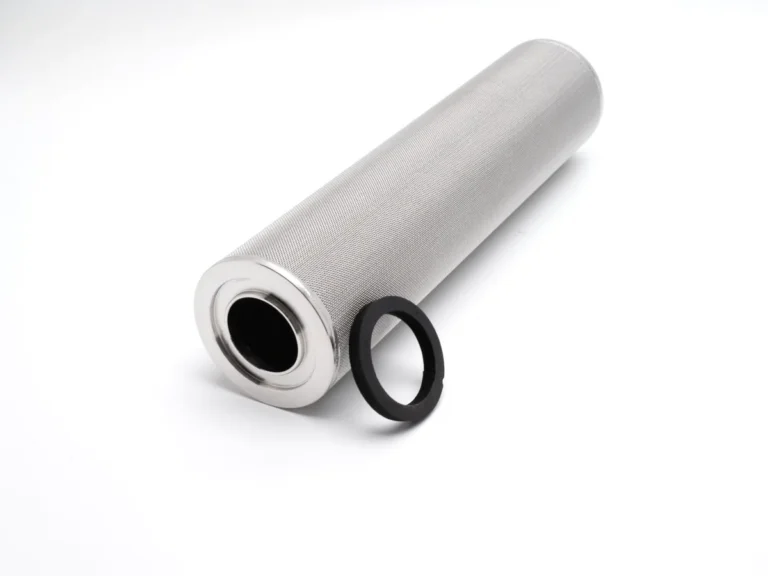
The filter media is folded into accordion-style pleats. This increases the active filtration surface by up to 300% compared to a plain cylindrical cartridge of the same size.
What that buys you:
- Higher flow rate without adding filter housings
- Greater dirt-holding capacity — longer intervals between cleaning
- Lower pressure drop across the filter element — less energy consumption
Process engineers designing high-throughput systems — water treatment plants, chemical reactors, polymer extrusion lines — often find that pleated cartridges eliminate the need for oversized pump capacity or parallel housings.
Industry Applications
Chemical Processing
Catalyst recovery and solid-liquid separation are core applications. The precise absolute micron ratings (3–200 μm) let engineers specify exactly how fine the separation needs to be. Stainless steel handles the chemical environment without contaminating the product stream.
Pharmaceutical Manufacturing
Pharma processes need filters that:
- Don’t shed particles (no fiber shedding from metallic mesh)
- Can be steam sterilized or chemically sanitized between batches
- Produce documented, validated performance data for regulatory compliance
The electropolished smooth surface of sintered stainless steel mesh is easy to inspect and clean, which supports USP/FDA validation requirements. Certificates of conformance and material traceability documentation are available with every order.
Water Treatment
Municipal and industrial water treatment plants value the cleanable design. Backwashing without cartridge removal saves significant labor in high-volume systems. The corrosion resistance of 316L makes these cartridges suitable for both fresh water and treated seawater applications.
Oil & Gas
Offshore and refinery applications need filters that resist the combination of chloride, hydrocarbons, pressure, and sometimes H₂S. Standard stainless steel handles most applications; duplex or 904L grades are available for more aggressive service.
Customization: Fitting Into Your Existing System
Off-the-shelf configurations cover most standard housings:
- Outer diameter: 30 mm to 350 mm
- Length: 10″ to 60″
- End caps: DOE, SOE with 222/226 O-ring, flange connections
- Micron rating: 3 μm to 200 μm absolute
If your housing is non-standard or your application requires a specific pleat pitch or end fitting, custom configurations are manufactured to order. The engineering team reviews your system parameters and confirms compatibility before production.
Reusability and Total Cost of Ownership
Disposable cartridges have a simple cost model: buy, use, discard, repeat. The total cost adds up faster than it appears when you factor in replacement labor, disposal, and the downtime required for each changeout.
Pleated SS wire mesh cartridges are cleaned and reused. A typical cleaning cycle:
- Backflush with clean process fluid or water (removes surface deposits)
- Ultrasonic cleaning in appropriate solvent (removes embedded particles)
- Optional chemical soak for stubborn fouling
Cartridges typically run 12–24 months between replacements, versus 30–90 days for standard disposable filters. The maintenance schedule becomes predictable — planned, rather than reactive.
Quality Assurance
Each cartridge is tested before shipment:
- Material and dimensional inspection — documented as agreed for the order
- Flow rate characterization — verifies pressure drop vs. flow relationship
- Burst pressure test — confirms structural safety margins
- Dimensional inspection — confirms fit with specified housing
FILTURE holds ISO 9001 certification and provides full material traceability. Documentation packages for regulated industries (pharma, food & beverage, defense) are available on request.
Talk to FILTURE About Your Filtration Needs
Every filtration job is different. If you’re not sure which cartridge fits your system, see the full specifications for our SS Pleated Mesh Filter Element and SS Sintered Mesh Filter Element, or request a quote with your dimensions, micron rating, and operating conditions.
Prefer email? Reach us at sam.young@filturemetal.com — we’ll get back to you with a straight answer, no sales pitch.