
Confirm material compatibility for the actual medium, concentration, temperature and operating conditions before ordering. Titanium is not specified here as universally resistant to hydrochloric or sulfuric acid.
Why Titanium Instead of Stainless Steel
The case for titanium comes down to chemistry. Pure titanium (Grade 2) forms a stable, self-healing oxide layer (TiO2) that resists attack by a range of aggressive media:
- Hydrochloric acid (HCl): Confirm material compatibility for the actual medium, concentration, temperature and operating conditions before ordering. Titanium is not specified here as universally resistant to hydrochloric or sulfuric acid.
- Sulfuric acid (H2SO4): Confirm material compatibility for the actual medium, concentration, temperature and operating conditions before ordering. Titanium is not specified here as universally resistant to hydrochloric or sulfuric acid.
- Wet chlorine and chloride brines: This is where titanium really earns its cost premium. In chlor-alkali plants and many high-chloride services, titanium offers far better resistance to pitting and crevice corrosion than 300-series stainless steels, which are much more vulnerable in these environments.
- Seawater: Titanium has decades of proven service life in seawater without measurable corrosion, while 316L will pit in stagnant or low-flow seawater zones.
- Biocompatibility: Pharmaceutical and food-contact suitability must be assessed for the finished component and intended use. Material grade alone does not establish biocompatibility or regulatory compliance; agree the required evidence before ordering.
There is also a weight advantage. Titanium has a density of 4.51 g/cm3 versus 8.0 g/cm3 for 316L — roughly 44% lighter. For large filter housings with multiple elements, this reduces the structural load on supports and piping.
Key Specifications
Material: Pure titanium, Grade 2 (ASTM B348 / ASTM B381)
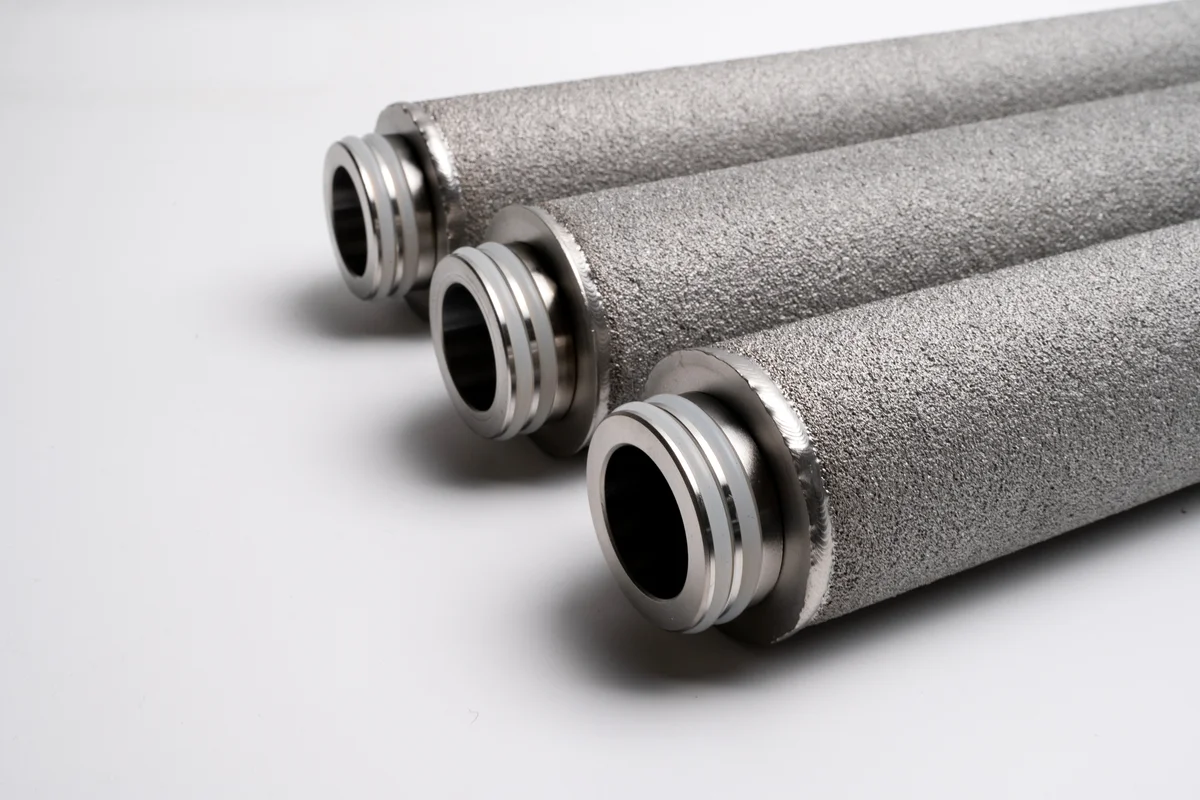
Pore size range: 0.22 – 100 µm
Max operating temperature: 400°C
Max differential pressure: approximately 0.6 MPa (wall thickness dependent)
Porosity: 30 – 45%
Standard tube OD: 14 – 200 mm
Length: 100 – 1200 mm
Wall thickness: 2 – 10 mm
Manufacturing Notes
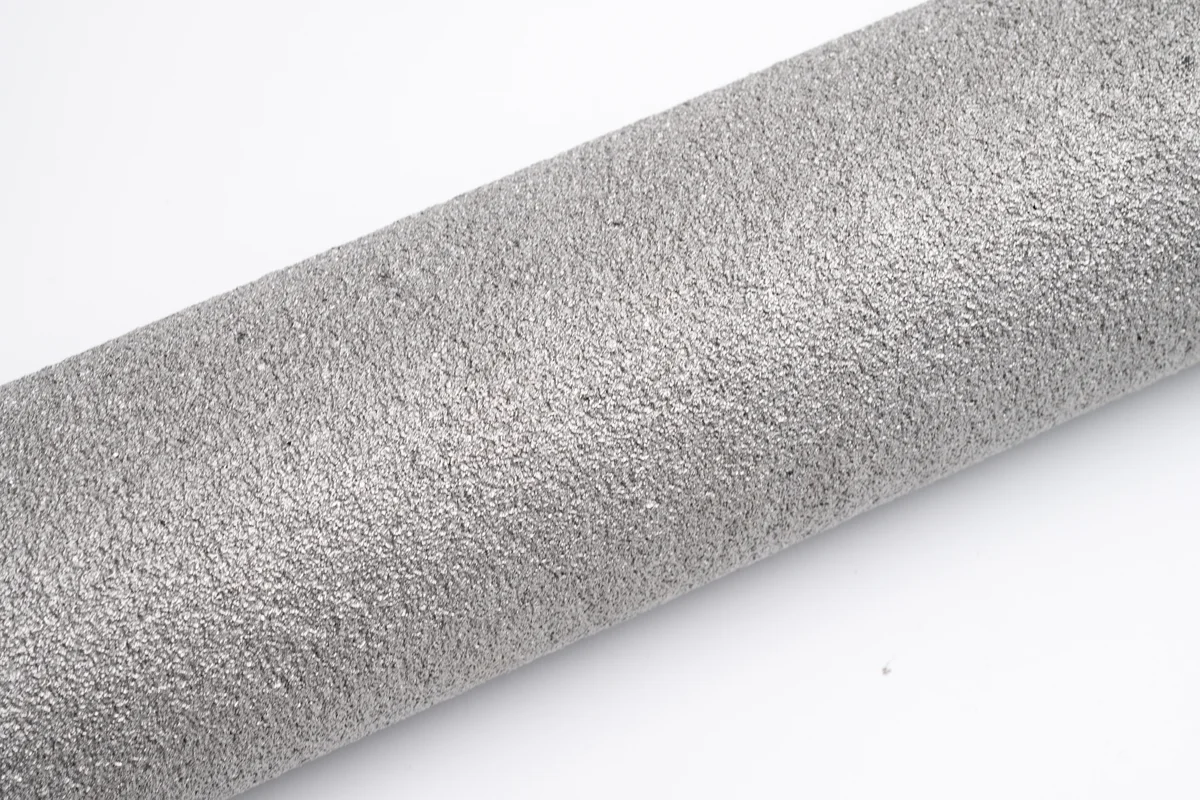
Titanium sintered powder elements are made by the same general process as their stainless steel counterparts — powder compaction followed by vacuum sintering. However, titanium requires more careful atmosphere control during sintering. Titanium is highly reactive with oxygen and nitrogen above about 500°C, so sintering must be done in high vacuum (typically below 10-3 Pa) or in ultra-pure argon to prevent embrittlement. The sintering temperature for pure titanium is in the range of 1000-1200°C, held for several hours to achieve full metallurgical bonding.
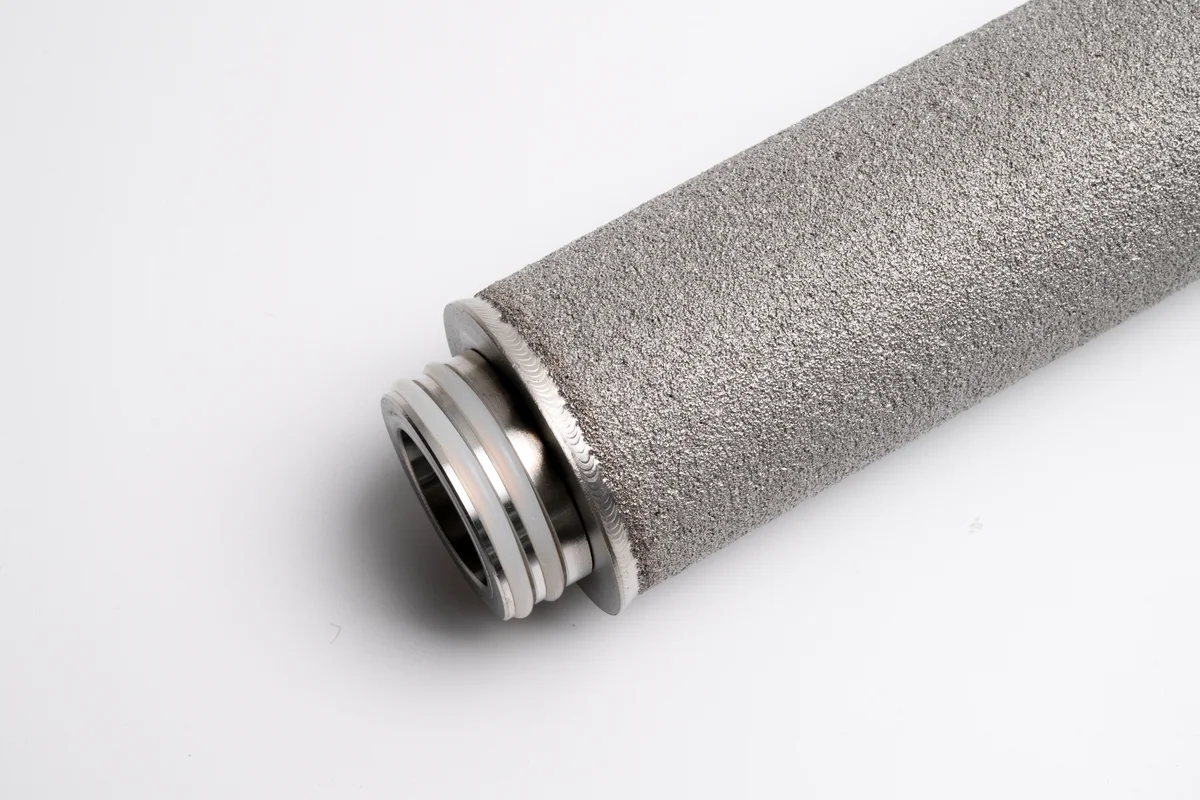
This atmosphere sensitivity is one reason titanium elements cost more than 316L equivalents — the vacuum furnace cycle is longer and the purity requirements for both the powder feedstock and the furnace environment are stricter.
Applications
Chlor-Alkali and Brine Filtration
Chlor-alkali plants electrolyze brine (NaCl solution) to produce chlorine, caustic soda, and hydrogen. The brine feed must be filtered to protect the ion-exchange membranes in the electrolysis cells — even small particles can damage these expensive membranes. Titanium sintered powder filters in the 1-10 µm range handle this duty without corroding in the saturated chloride environment. Stainless steel filters in the same service would pit and contaminate the brine with iron and chromium ions.
Offshore and Seawater Systems
Seawater injection systems on offshore platforms, shipboard ballast water treatment, and desalination pretreatment all need filters that survive continuous saltwater exposure. Titanium sintered elements have a long service record in seawater, including stagnant or fouling-prone zones where crevice corrosion often limits stainless steel service life. They can also be backwashed with the same seawater in many systems without the corrosion concerns associated with stainless alternatives.
Pharmaceutical Bioprocessing
Pharmaceutical and food-contact suitability must be assessed for the finished component and intended use. Material grade alone does not establish biocompatibility or regulatory compliance; agree the required evidence before ordering.
Semiconductor Wet Processing
Confirm material compatibility for the actual medium, concentration, temperature and operating conditions before ordering. Titanium is not specified here as universally resistant to hydrochloric or sulfuric acid.
Cost Considerations
Titanium sintered powder elements are generally priced above equivalent 316L elements, although the gap varies widely by size, wall thickness, powder grade, and order quantity. In some project quotations the difference is modest enough that the corrosion-life advantage outweighs the initial premium very quickly.
Factor in service life and the economics tilt further in titanium’s favour. In applications where 316L corrodes and needs replacing every 6–12 months, a titanium element lasting 5+ years delivers a significantly lower total cost of ownership.
Confirm material compatibility for the actual medium, concentration, temperature and operating conditions before ordering. Titanium is not specified here as universally resistant to hydrochloric or sulfuric acid.
For detailed specifications and dimensional options, see our titanium sintered powder filter product page. If you need porous titanium in plate or disc form rather than filter cartridges, visit our porous components page.